

The establishment of collective security architectures by states in regions of high conflict potential, joint exercises, intelligence sharing, and mutual defense commitments constitutes a classical behavioral pattern in the international relations literature known as "balancing." The most deeply rooted of these structures is NATO, which has been operating since 1949. Although visible tensions have emerged in transatlantic relations in recent times, the 36th NATO Summit of Heads of State and Government, held in Ankara on 7–8 July 2026, presented, at least on its visible surface, a positive picture of intra-alliance relations; at the close of the summit, US President Trump reaffirmed his commitment to the alliance, stating, "We want to stay with you." Beyond what was reflected in the media, however, the dynamics of behind-closed-doors negotiations can always be read differently. Indeed, during the summit, Trump directly raised the issue of the US strikes against Iran, stating that targets inside Iran had been hit very hard the previous night, that the US would retaliate if attacked, and that it would ensure Iran's denuclearization. In this context, it was not an unexpected scenario for the United States to produce rhetoric directly targeting Iran while hosted by a state such as Turkey, which pursues a moderate foreign policy; it was foreseeable that one of the core motivations behind US participation in the summit was to send a deterrent message to Iran and to defend US interests at the highest level.
The Structural Fragility of the Middle East
Following the erosion of Ottoman influence in Palestine and the wider Middle East, the borders constructed by the British and French mandate order (in the aftermath of Sykes-Picot) structurally disrupted identity-based state-building in the region. Israel's rise as a regional power following the completion of its societal and institutional construction process that began before 1948 triggered numerous conflicts, including the Six-Day War of 1967; yet the military moves undertaken against an aggressor state failed to move beyond deepening the regional crisis. Against this fragile backdrop, Iran's advances in nuclear capability and its missile program came to be read by the West as a threat. Tensions around the Strait of Hormuz in particular through which a significant share of global oil trade passes and the risk of its closure once again demonstrated how deeply interconnected world trade is, and how much more dependent the international system is on a wider set of actors than is commonly assumed.
The Mecca Joint Defense Agreement: Legal Framework, Provisions, and Timing
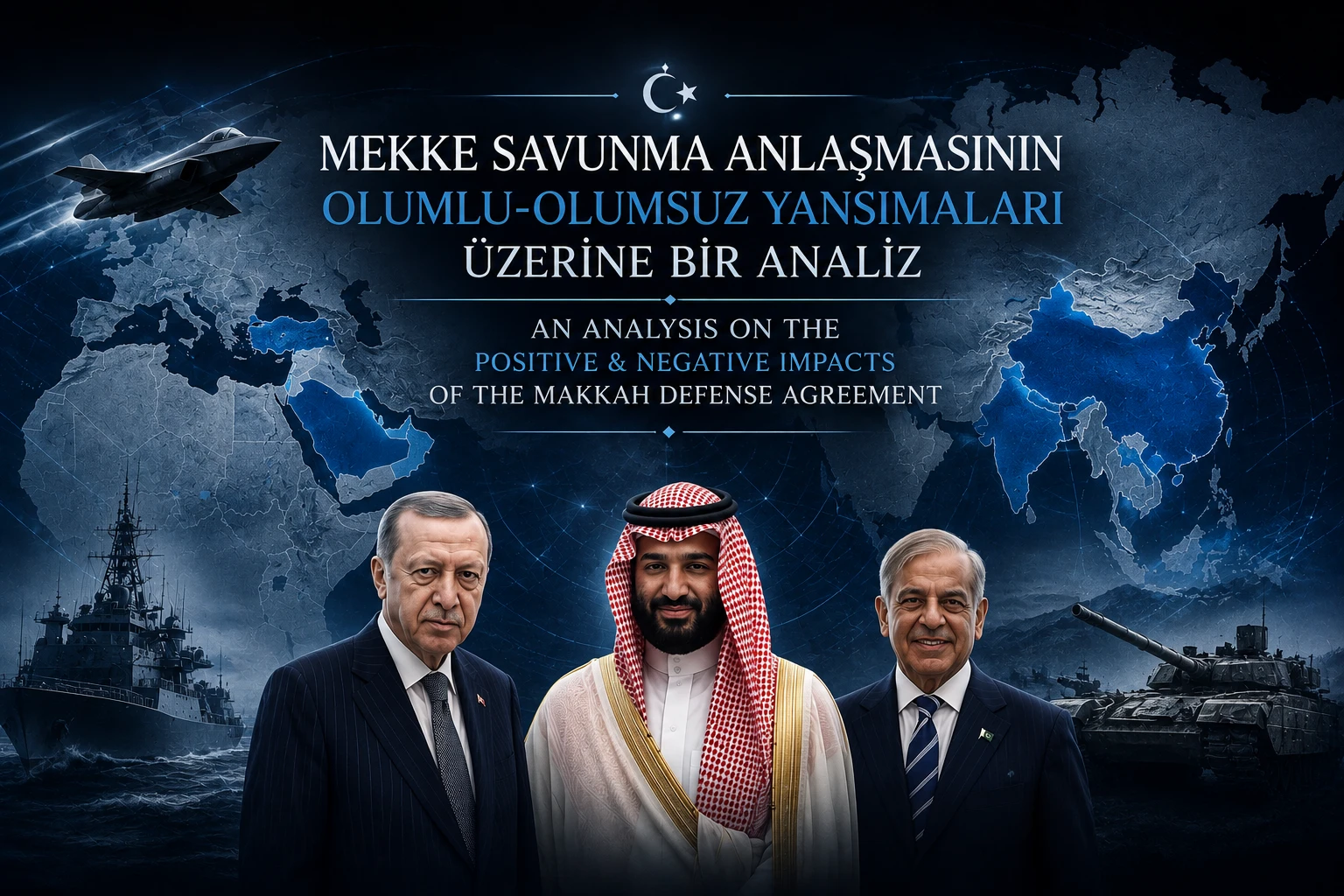
Within this atmosphere, on 7 August 2026, the "Mecca Joint Defense Agreement" was signed at the Safa Palace in Mecca by President Recep Tayyip Erdoğan, Saudi Crown Prince Mohammed bin Salman, and Pakistani Prime Minister Shehbaz Sharif. The agreement's core elements can be summarized as follows:
- Legal basis:The agreement is grounded in the right of self-defense set out in Article 51 of the UN Charter. That is, it constructs the same legal logic as NATO's Article 5, within a trilateral framework.
- Collective defense clause:An armed attack against any one of the three states will be considered an attack against all three.
- Scope limitation:Official statements have emphasized that the agreement targets no country, that existing diplomatic channels will remain open, and notably that the pact does not imply the automatic deployment of Turkish troops to every regional crisis, as decisions on the use of force will continue to be made within Türkiye's constitutional decision-making mechanisms.
- Potential for expansion:Pakistani Defense Minister Khawaja Asif has stated that the framework could be expanded to include other countries, such as Qatar.
- Zone of ambiguity:The text of the agreement does not specify concrete military obligations that is, what level of intervention would apply in which scenario. This has prompted outlets such as the BBC to raise questions such as whether Türkiye would be obliged to become involved in Yemen should the conflict between Saudi Arabia and the Houthis reignite. This ambiguity can also be read as a form of deliberate strategic flexibility similar to that found in NATO's Article 5: by not binding themselves in advance, the parties preserve deterrence while also avoiding the risk of automatic entrapment.
This trilateral structure has an important historical precedent: the "Strategic Mutual Defense Agreement" signed between Pakistan and Saudi Arabia on 17 September 2025. According to Reuters reporting from May 2026, following that agreement Pakistan deployed approximately 8,000 troops, along with fighter aircraft, drones, and air defense systems, to Saudi Arabia. In other words, the Mecca Agreement is not built from scratch but is constructed atop an existing military integration.
The timing of the agreement also merits attention. Its signing took place just one month after NATO's Ankara Summit, and directly during Erdoğan's visit to Saudi Arabia. This sequencing invites a reading of the agreement not merely as a foreign policy move, but also as an exercise in domestic legitimacy-building and the assertion of regional leadership: Türkiye found an opportunity to simultaneously demonstrate both a strengthened position within NATO and a leading role within the Islamic world. The one-month gap between these two moves gives the impression of a calculated diplomatic calendar rather than mere coincidence.
A Three-Dimensional Risk Analysis
This agreement warrants evaluation along three separate axes.
a) The Saudi Arabia Axis — Reading through the Palestinian Question
When the dynamic of the relationship established with Saudi Arabia is read through the lens of the Palestinian question, it becomes clear that Riyadh holds a perspective considerably different from Türkiye's, standing closer to the United States and Israel. In addition, there are documented cases in which Saudi Arabia has armed paramilitary groups in the region, notwithstanding past agreements with Türkiye. Within such an equation, the principle that "an attack on one is an attack on all" carries the potential to drag Türkiye into unexpected diplomatic crises in the Middle East particularly given that Turkey's geopolitical strategy requires it to maintain a certain balance in its relations with Russia, a more pragmatic policy should be pursued in light of these risks.
b) The Pakistan Axis — The India Factor
Turning to the Pakistan dimension, this agreement carries the risk of cooling Türkiye-India relations along the existing line of India-Pakistan tension. Indeed, the Indian press has tended to read the agreement largely as a "Pakistan-centered regional bloc formation," and New Delhi will now be forced to take into account not only Pakistan's own military capacity but also which countries might offer diplomatic and technological support in a potential crisis. Regional reactions have also varied: it is notable that Israeli media has offered an assessment describing it as a "lethal alliance" that fills the gaps of the three countries, while some Turkish academics have interpreted the development as the de facto collapse of the Abraham Accords. However, the establishment of an alliance is not the same thing as that alliance achieving a successful dynamic and ensuring its continuity; initial reactions reflected in the media do not offer sufficient parameters for gauging states' ultimate approach. It would be far more sound to read the true dynamics of this alliance through the joint exercises, the scope of intelligence sharing, and the actual positions taken during moments of crisis as the process unfolds.
c) The Turkey-Israel Axis — Contradiction within the Alliance
A third dimension of the analysis that must not be overlooked is Türkiye's own relationship with Israel. Turkey has largely suspended its trade with Israel since May 2024; Israel's recognition of the Armenian Genocide in June 2026 further deepened this rupture, and tensions between the two countries particularly along the Syrian and Eastern Mediterranean fronts have at times reached a level where the possibility of direct confrontation has even been discussed. Saudi Arabia, by contrast, occupies a position relatively closer to Israel. This means that the two parties sitting at the table of the Mecca Agreement Türkiye and Saudi Arabia hold fundamentally different positions vis-à-vis Israel; consequently, despite the outward rhetoric of unity, the alliance carries an unresolved internal tension. This internal contradiction may, in the future, make it more difficult for the three countries to adopt a joint position in a theater such as Syria. Historically, Türkiye's moderate foreign policy has repeatedly mitigated the impact of similar crises; nevertheless, the extent to which the new alliance will genuinely protect "Muslim interests" remains an open question. While some commentators read the agreement as an implicit balancing element against Iran, such an inference should be treated as premature and approached with caution in the absence of an explicit definition of threat in the text, since every state behaves pragmatically in its own foreign policy a pattern that is, by the very nature of the international system, to be expected. Accordingly, Saudi Arabia's own dynamic relationship with Iran alone renders this claim insufficient.
Economic and Strategic Gains
On the positive side of the ledger, three principal gains stand out for Turkey:
- Arms transfers and economic revenue:In 2025, Türkiye exported 230 types of defense products to 185 countries, reaching a volume of USD 10.054 billion up from USD 5.5 billion in 2023 and USD 7.1 billion in 2024. Under the Mecca Agreement framework, deepened access to a high-purchasing-power market such as Saudi Arabia carries the potential to sustain this momentum.
- Intelligence sharing:A joint intelligence mechanism against threats potentially emanating from paramilitary groups or hostile states will provide significant operational convenience to all three states.
- Development of military production capacity:Knowledge-sharing between Pakistan's military production capacity and Türkiye's accumulated experience in defense technologies through joint production and technology transfer, itself a contested subject could contribute to enhancing the engineering capacity of both countries.
Risks: Blowback and Intelligence Leakage
These gains also carry costs that warrant attention. Arms sales may entail an increased risk of "blowback" the possibility that exported systems fall outside end-user oversight and end up in the hands of illegitimate formations, fueling regional conflicts. This risk takes different forms depending on the technology involved and the position of the parties concerned. Türkiye's exposure stems largely from its position as an exporter: because Turkey's oversight of the end-user of the systems it sells is limited under the direct-export model, this raises the likelihood of blowback in areas of direct security sensitivity for Türkiye, such as the PKK/YPG axis or Syria. Saudi Arabia's exposure, by contrast, stems more from its position as an active party to conflict: weapons deployed in an arena such as the Houthi front in Yemen may be lost or change hands. "Blowback," therefore, is not a single category but two distinct risk profiles that must be managed differently according to the exporter/deployer distinction.
A second area of risk concerns intelligence sharing: unless adequate countermeasure strategies are developed against espionage activities, it is plausible that shared intelligence could leak and that the true scale of a given threat could be misjudged. This, in turn, could lead states to respond belatedly to a crisis.
Conclusion
The Mecca Joint Defense Agreement is a historic yet ambiguous step taken against the backdrop of the Middle East's unending cycle of new-generation conflicts: its legal foundation is clear (Article 51 of the UN Charter), and its declaration of political intent is strong, yet concrete military obligations remain undefined an ambiguity that can partly be read as deliberate strategic flexibility. For Turkey, the potential economic and strategic gains are significant; however, three separate lines of tension the Saudi-Israel-US rapprochement, the India-Pakistan conflict potential, and the Türkiye-Israel contradiction within the alliance itself will make Türkiye's traditional balancing foreign policy reflex even more critical going forward. The ultimate value of the agreement will be measured not by today's rhetoric, but by the actual joint exercises, the depth of intelligence sharing, and the real positions taken in the event of a future crisis.
İsrail’in Haziran 2026’da Ermeni Soykırımı’nı tanıması” ifadesiyle bu süreci tamamlanmış bir olay gibi sunuyor; oysa gerçekleşen yalnızca İsrail kabinesinin 28 Haziran’da tanıma teklifini oybirliğiyle onaylayıp Knesset’e sevk etmesiydi. Resmî ve nihai tanıma için gereken Knesset genel kurul oylaması 14 Temmuz’da, Azerbaycan’ın Netanyahu üzerindeki baskısı ve Ankara ile gerginliği düşürme kaygısıyla askıya alındı; metnin yazıldığı 7-8 Ağustos 2026 tarihi itibarıyla tanıma hâlâ tamamlanmamıştı. Dolayısıyla bu, Türkiye-İsrail geriliminin “derinleştiği” iddiasının dayanağı biraz zayıflıyor — kararın kendisi gerilim yarattı, ama süreç fiilen yarıda kaldı.
Trumpun sözleri Avrupa sanayi harcamaları içindi İran’da doğrudan ilişkisi hatalı