

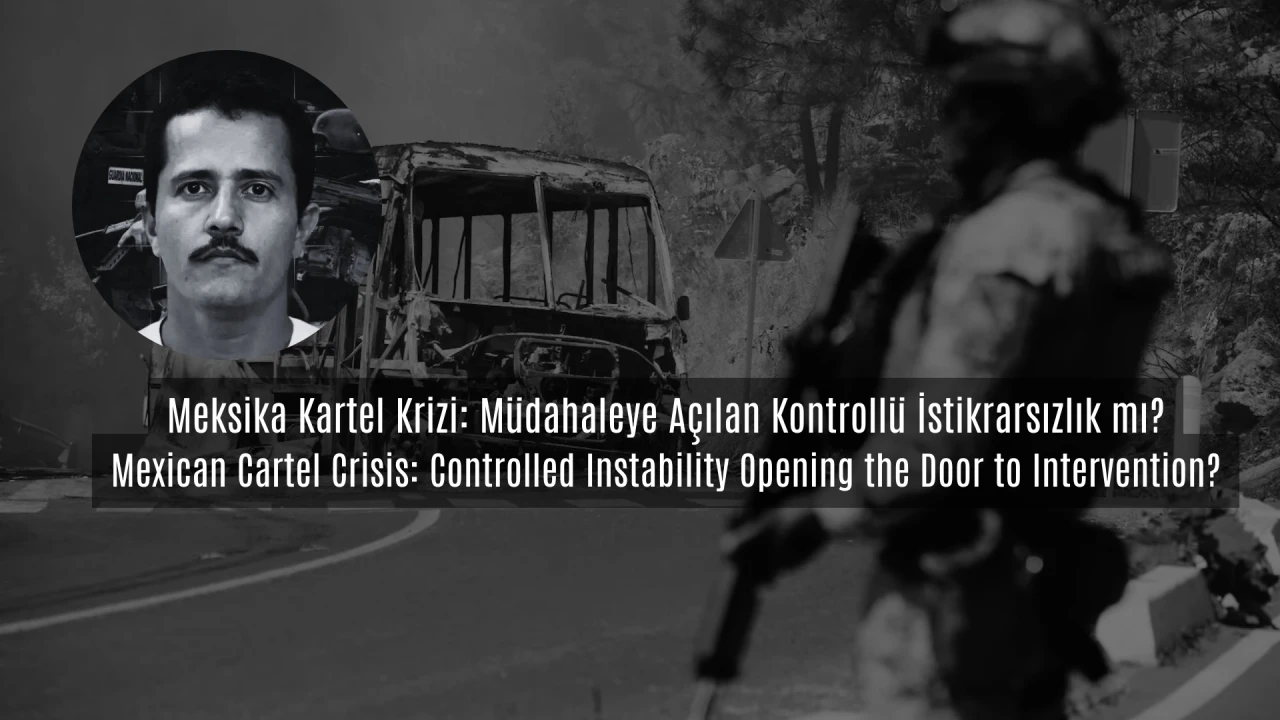
On the morning of February 22, 2026, a highly sensitive operation in Tapalpa, Jalisco State, Mexico, plunged the country into the greatest wave of chaos in recent years. With the neutralization of Rubén Nemesio Oseguera Cervantes, also known as "El Mencho," the leader of the Jalisco New Generation Cartel (CJNG), the streets of Guadalajara turned into a war zone: vehicles were set ablaze, airport raids occurred, and emergency curfews were issued to the public… However, this strategic move was not the end of a "victory" as might be thought; rather, it was the beginning of a far more complex and dark chapter in a structural crisis. El Mencho's death was not merely a change of names in the criminal underworld but a turning point that compelled us to examine the depths of the cartel structure, shaking modern security doctrines.
Today, categorizing structures such as the CJNG using the classic definition of organized crime is a strategic mistake. These structures are now defined in the literature as "Non-State Armed Actors" (NSAIDs) and constitute a "Hybrid Threat" to national security. The system established by these cartels is not limited to generating violence; it also creates "grey areas of sovereignty" in certain geographical areas by limiting the state's legitimate use of force.
In these areas, cartels weaken state capacity from within and build parallel systems. These structures, which bind local governments, security forces, and economic actors to themselves through corruption, fear, and coercion, claim to offer the public an alternative social and economic order. Capable of paralyzing public order within minutes through urban blockades, infrastructure sabotage, and coordinated military attacks, these semi-military forces completely blur the institutional boundaries between internal security and national defence.
The Fentanyl ParadoxThe biggest financial fuel behind the operational capacity of cartels is the trade in synthetic drugs, especially fentanyl. Historically, it was first introduced in Belgium in 1960 by Dr. Synthesized by Paul Janssen, this substance has been transformed from a medical analgesic into a global security crisis. The technical power of fentanyl and the paradox it creates overshadow traditional drugs:
Fentanyl is 100 times more potent than morphine and 50 times more potent than heroin.
According to DEA data, just 2 mg (a dose the size of a pencil tip) is enough to kill a person.
Unlike heroin, fentanyl is not dependent on natural resources (e.g., opium fields). It can be produced in illegal laboratories as well.
This synthetic nature provides cartels with a huge logistical advantage and profit margins.
The leader-focused operations known as "Kingpin Strategy," which security forces have been employing for years, are ineffective against the cartels' flexible "network-type structures." While events like El Mencho's death or El Chapo's arrest may provide short-term symbolic victories, in the medium term, they lead to fragmentation and escalation of violence and the mutation of organizations.
Control over a highly profitable and easily produced commodity, such as fentanyl, allows these structures to rapidly renew themselves financially. Even if the leader dies, as long as the main engines of the system— the demand and flow of weapons—are not interrupted, the "dragon" will only produce new heads. The organization will find a way to renew itself in the future. The problem is not that the cartels are leaderless; the real problem is the continuation of the structural imbalance between supply and demand.
The most tragic paradox of the Mexican cartel crisis is the dual role of the US in this equation. The Washington administration is both a "firefighter" trying to put out the fire and an "arsonist" fanning the flames.
Armory and "Iron River": More than 70% of the weapons seized in cartel operations are of US origin. Lax gun regulations in states like Texas and Arizona are the main source of the arms smuggling chain flowing towards Mexico, known as the "iron river."
The fact that annual fentanyl-related deaths in the US range between 70,000 and 80,000 demonstrates the seriousness of this problem. However, Washington has failed to overcome the influence of gun lobbies in domestic politics and implement structural reforms to cut off the flow of weapons and reduce the demand for drugs in society.
To use a historical analogy, just as the mafia gained immense power during the Prohibition era of the 1920s as long as demand persisted, today's prohibitionist and operation-focused policies similarly feed the cartels. Prohibition only serves to maximize the income and strategic power of organized crimes.
Conclusion: Is a Breakthrough PossibleSimilar to the processes experienced in Colombia after FARC or the Medellín cartel, the elimination of the leader could create a new power vacuum and potential internal conflicts. The risk of the CJNG disintegrating increases, while rivals like the Sinaloa Cartel are likely to strengthen their position. Could this chaotic situation pave the way for the Trump administration to justify a more direct military intervention or large-scale operations in the coming days, using the rhetoric of "The Mexican people are not alone, we stand with them"? Historical examples (Panama 1989, Colombia Plan Colombia) show that such rhetoric often translates into increased military presence under the guise of "humanitarian aid" or "shared security.
The existence of an active conflict provides fertile ground for legitimizing external interventions. The narrative of "the Mexican government cannot protect its own people, we stand with the Mexican people" can become the justification for a military operation in the coming days. The current US pressure on Venezuela, Greenland, and Iran demonstrates the familiarity of this scenario.
Mexico's 130 million population, its status as the world's 15th largest economy, its 3,000-kilometer shared border, and the USMCA trade agreement make direct military intervention an extremely costly move from diplomatic, economic, and symbolic perspectives. A more likely scenario is not an overt invasion but a model of "greenlighted operations": operations on Mexican soil effectively directed by the US but carried out by Mexican forces. While formal sovereignty is preserved, the de facto control shifts. Plan Colombia was precisely this: Colombia was sovereign on paper, but the US was the real actor on the ground.
The real danger is this: what will happen if Mexico's internal instability deepens and the government reaches, or appears to reach, a point of "we can't do it," thus paving the way for the US to step in at its invitation?
Kalkan, Z. (Yıl bilinmiyor). Olası küresel sorun: Fentanil tehdidi. Polis Dergisi. Polis Akademisi. https://polisdergisi.pa.edu.tr/olasi-kuresel-sorun-fentanil-tehdidi-2143-haber
Birleşmiş Milletler Uyuşturucu ve Suç Ofisi (UNODC). (2022). Three precursors of the most common synthesis routes used in illicit fentanyl manufacture now under international control. https://www.unodc.org/LSS/Announcement/Details/b152bda5-5d71-4f7e-9d68-1bdd9af04a83
Birleşmiş Milletler Uyuşturucu ve Suç Ofisi (UNODC). (2023). Dünya uyuşturucu raporu 2023: Executive summary. UNODC.
CNN. (t.y.). World Americas: Mexico. https://edition.cnn.com/world/americas/mexico
Mexico News Daily. (t.y.). https://mexiconewsdaily.com/
Kalkan, Z. (2024, 16 Aralık). Olası küresel sorun: Fentanil tehdidi. Polis Dergisi.
Gazete Oksijen. (t.y.). Eski bir polisten bölgenin en tehlikeli uyuşturucu karteline: Ölümüyle Meksika’yı birbirine katan El Mencho kimdi? https://gazeteoksijen.com/dunya/eski-bir-polisten-bolgenin-en-tehlikeli-uyusturucu-kartelineolumuyle-meksikayi-birbirine-katan-el-mancho-kimdi-266605
No comments yet. Be the first!