

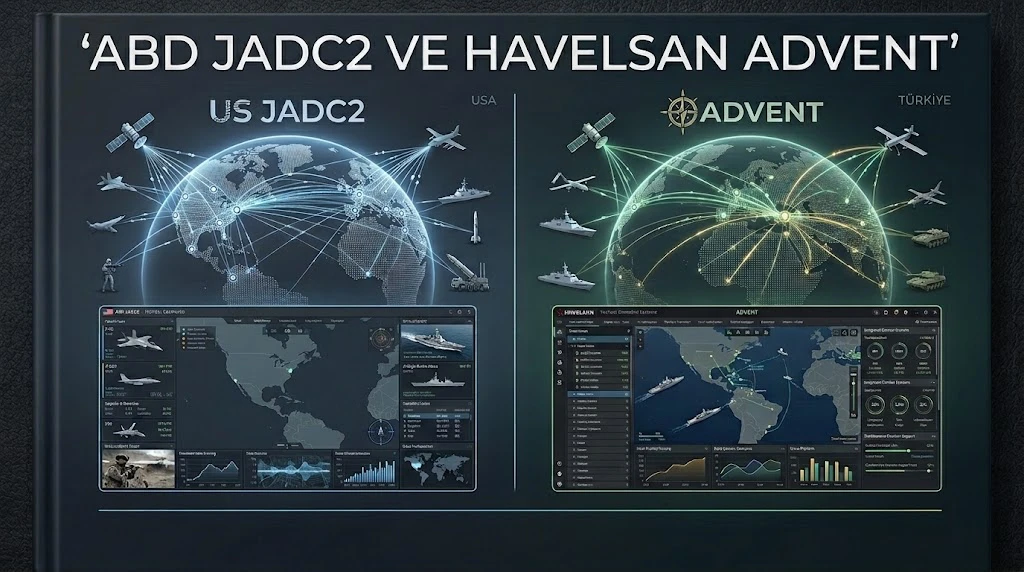
In the history of military technology, the decisive breakthroughs have usually come not from the invention of a new weapon but from combining existing tools within a new order and using them as strategic instruments. The machine gun, reconnaissance and surveillance assets, the tank, and unmanned aerial vehicles (UAVs) are, on their own, simply tools. What changes the course of war is largely the organizational form that brings these tools together under a common doctrine. As the number of unmanned vehicles grows rapidly, the central issue is no longer the capability of individual systems but the degree to which these vehicles can operate together under a common chain of command. In the Turkish defense industry, this approach is known as Dijital Birlik (Literally "Digital Unit"; a concept promoted by HAVELSAN for integrating manned and unmanned platforms under a common command-and-control architecture. The company's English-language materials refer to it as "Digital Troops.")
1. The US JADC2 Program
The idea of bringing assets from different operational domains into a single command layer originated in the Pentagon, not in Türkiye or Ukraine. The Joint All-Domain Command and Control (JADC2) concept, under development since 2019, aims to connect selected US assets across the space, air, land, maritime, and cyberspace domains. In 2023, a rebranding that emphasized interoperability with allies renamed the program Combined JADC2 (CJADC2). More revealing, however, is the capability the program has actually reached. In an audit report published in April 2025, the US Government Accountability Office (GAO) made a significant finding. Although the Department of Defense (DOD) has been trying to define CJADC2 since 2019, it has yet to establish a comprehensive framework to guide investments and measure progress. The Army, Navy, and Air Force continue to develop their own data integration capabilities largely independently of one another. Overly restrictive data classification, in turn, poses a serious obstacle to sharing command-and-control data. Officials interviewed by GAO reported that no office is even tasked with resolving this problem and that CJADC2 leadership considers the matter outside its purview.
"Without identifying and addressing key challenges, DOD's progress toward its CJADC2 goals will be limited."
— US Government Accountability Office (GAO), GAO-25-106454, April 2025
This finding also provides a benchmark for the rest of the article. The country with the world's largest defense budget and the longest institutional experience has, after six years of effort, still not managed to integrate assets from different operational domains into a single data architecture. The Turkish and Ukrainian cases should be read against this background.
2. Ukraine: Claims of Scale and the Problem of Verification
The Russia–Ukraine war offers an unprecedented setting for the intensive use of unmanned systems, yet most of the figures emerging from it rest on statements by the belligerents and cannot be independently verified. A study published in the peer-reviewed RUSI Journal summarizes where data on one-way attack drones come from: statements by Russian officials, footage circulating on social media, Ukrainian military statements to the press, and general news coverage. The same study stresses that most of these reports contain "questionable elements" and that the reliability of Russian claims is contested, particularly regarding the size of attacks and whether they were intercepted.4 Independent news outlets have reported even Commander-in-Chief Oleksandr Syrskyi's monthly figures for destroyed targets with the caveat that they "could not independently verify" them.5
With this caveat in mind, attributed belligerent statements present the following picture.
| Indicator | Figure | Source / period |
| UAVs Ukraine reports having received | ~500,000 | June 2026; 95% domestically produced |
| Monthly destruction reported by the Unmanned Systems Forces | 1,200+ | May 2026 |
| Reported assembly cost of an FPV kamikaze drone | $400–500 | 2025–2026 assessments |
Setting aside the verifiability problem, the trend these figures point to is clear: low-unit-cost systems are being used at numerical scale. This is a common observation in Russian and Ukrainian sources as well as in independent academic assessments. The Unmanned Systems Forces, established in 2024 as a separate service branch, can likewise be treated as an institutionally verifiable development.
On autonomy, Ukraine's own official policy confirms the distinction this article seeks to draw. Ministry of Defense rules require a human to remain in the loop for combat decisions, meaning that human operators confirm the target in the final stage of an engagement. In July 2025, Mykhailo Fedorov, then Minister of Digital Transformation, said that Ukraine had used in Crimea a drone that selected its target without a link to a human pilot. He added, however, that the drone had not entered serial production.6 Fully autonomous engagement thus remains an exceptional experiment on the battlefield; the norm is still a system subject to human control.
The presence of hundreds or even thousands of unmanned assets in the same area of operations is not a capability in itself but a management problem. Where each vehicle requires its own operator, console, and data format, adding more vehicles can reduce effectiveness beyond a certain threshold. This is precisely the problem GAO identified in the US program. DOD components have historically developed complex systems that struggle to share data with one another, chiefly because of service-specific requirements, siloed development processes, and proprietary contractor architectures. The critical technology is not the vehicle itself but the software that integrates it into a common tactical picture, and this problem is more universal and harder to solve than is often assumed.
One example illustrates progress on the battlefield. In September 2026, Ukraine's 3rd Army Corps announced as a "world first" an operation in which air-delivered kamikaze ground robots were landed more than 10 kilometers behind Russian lines. An independent Russian-language news site, however, reported that such deliveries were not entirely new for Ukraine and that this was simply the first time they had been carried out at that distance.7 The episode suggests that integrating unmanned assets from different domains under a single mission plan is no longer experimental. It also shows that sources diverge even on the scope of the claim.
On the architectural side, the core of the problem is a unified data model. If the command system on a manned platform and the mission system aboard an unmanned vehicle do not share the same data structures and communications infrastructure, every interaction between them requires a translation layer, which in turn introduces latency and error. This is the technical core of what NATO literature discusses under the heading of manned-unmanned teaming (MUM-T).
3. The Turkish Case: The ADVENT Family
According to HAVELSAN's corporate history, the ADVENT project began in 2010 in cooperation with the Turkish Naval Forces' Research Center Command (ARMERKOM). After an extensive factory acceptance testing process, the first official version of the system entered service aboard the corvette TCG Kınalıada (F-514) in March 2019.8,9 According to the company, Turkish engineers developed the software by writing approximately 6 million lines of code.9 HAVELSAN's current data indicate that ADVENT CMS is now in active use on more than 85 platforms across the surface, subsurface, and air domains.10 The system's extension to unmanned assets comes not from a single product but from a layered family structure.
Functional layers of the ADVENT family (HAVELSAN corporate sources)
The defining feature of the architecture is that ADVENT ROTA uses the same data structures and communications infrastructure as the main system. This enables direct command and data flow between ADVENT-equipped platforms and unmanned vehicles. The first concrete application of this approach is the SANCAR armed unmanned surface vessel (USV), built through a partnership between HAVELSAN and Yonca Onuk Shipyard, which has completed its initial tests. HAVELSAN describes ADVENT CMS as a "rule-based and integrated decision support system." When detections match rules defined by the operator, the system can alert and inform the operator and automatically execute predefined actions. This description is consistent with the human-in-the-loop emphasis of the previous section: the system supports decisions but does not replace them.
HAVELSAN's official project list shows that ADVENT is used not only by the Turkish Naval Forces but also in the combat management system projects for MİLGEM (Milli Gemi (National Ship), Türkiye's indigenous naval shipbuilding program, which produced the Ada-class corvettes.), the Pakistan Navy corvettes, the Ukrainian Ada-class corvette, the landing helicopter dock (LHD), and offshore patrol vessels.10 Under a 2025 agreement with the Chilean Navy, ADVENT is to be installed on two frigates, which extends the system's presence to four continents: Asia, Europe, Africa, and South America.
Industrial Indicators
Export data show the industrial counterpart of these technological claims more clearly. According to Haluk Görgün, President of the Presidency of Defense Industries (SSB), the sector closed 2024 with $7.1 billion in exports and 2025 with approximately $10.054 billion, an increase of about 48%. Of this total, $9.87 billion came from goods and $184 million from services. In the same statement, Görgün noted that the share of defense and aerospace in Türkiye's total exports rose to 3.7%, up from 2022, when sector exports stood at $4.4 billion.
This trajectory should not be read as a purely commercial development. A country that exports command-and-control software sells the buyer an operational architecture, not a single platform. Because the buyer must remain tied to the same data standard in subsequent procurements, software exports create a long-term relationship of dependence and influence. For this reason, combat management systems are among the defense export items with the greatest strategic weight.
Discussion
The rapid progress of the field should not overshadow the question of whether its claims can be verified. GAO has formally documented this problem even in the most mature program, that of the United States. This shows that the issues below are structural problems of the field rather than speculative concerns.
The first issue is the ambiguity surrounding levels of autonomy. In publicly available accounts, the tasks performed autonomously are navigation, reconnaissance, surveillance, and patrol. Ukraine's official policy requires human approval for combat decisions, and HAVELSAN's own description refers to decision support. "Requiring no personnel" does not mean "free of human control."
The second issue is data classification and institutional fragmentation. The most critical problems GAO identified in the US case are overly restrictive data classification and the isolated development efforts of the military services. This problem is likely to be less pronounced in closed-architecture systems tied to a single manufacturer and more pronounced in systems involving multiple stakeholders and allies. The loss-of-connectivity scenario also remains unaddressed. Publicly available sources leave it unclear whether a centralized command architecture carries a single-point-of-failure risk and to what extent vehicles can continue their missions independently once the link is severed.
The third issue is the cyberattack surface. Software-centric architectures create a larger attack surface than hardware-heavy systems. This is an unavoidable cost of gains in autonomy.
Finally, belligerent claims cannot be verified. Casualty and destruction figures from Ukrainian and Russian sources cannot be systematically cross-checked. The difficulty is not only a matter of propaganda; it is also a methodological problem for measuring actual effectiveness on the battlefield.
Conclusion
The change in the conduct of war is the product not of a single technological leap but of the intersection of three trends: falling unit costs, rising production volumes, and the maturation of a software layer capable of managing this mass. The first two have become roughly observable in Ukraine, despite the verifiability problems of belligerent claims. The third has not yet been achieved in any country. As GAO found with respect to its own government, even the actor with the largest budget in this field has not built a comprehensive framework after six years of effort.3 This clarifies the scope of the claim advanced at the outset: Dijital Birlik is not a completed capability but a shared goal that the world's most advanced defense industries are still pursuing.
Türkiye's position in this equation is the product of sustained efforts to build defense technology capacity. Its defense industrial base was constrained by various embargoes after Türkiye's 1974 military operation in Cyprus. Owing to its recent operational and export performance, Türkiye now ranks 11th in global arms and defense exports. As technology and engineering capabilities advance, Turkish defense systems may become more widely preferred, and Türkiye's alliance relationships may take on a new dimension. According to HAVELSAN's corporate sources, the ADVENT family, developed since 2010 and now used on more than 85 platforms, is a concrete indicator of this transition.10 The real test of this claim, however, will not take place at trade-show demonstrations or in controlled exercises. It will take place under actual operational conditions marked by intense electronic warfare, intermittent communications, and ambiguous target discrimination. The US CJADC2 has not yet passed that test either. At this stage, the most accurate assessment is the following. If integrated systems capable of collective action prove operationally successful, they will provide significant support for intelligence, surveillance, and reconnaissance (ISR) and for active engagement while minimizing personnel losses. Selling domestically developed systems to other countries and observing their performance in the field will therefore be an important input for the further development of this technology.
References
1. U.S. Government Accountability Office, “Defense Command and Control: Further Progress Hinges on Establishing a Comprehensive Framework”, GAO-25-106454, 8 Nisan 2025. gao.gov
2. Breaking Defense, “Return of CJADC2: DoD officially moves ahead with 'combined' JADC2 in a rebrand focusing on partners”, 2023. breakingdefense.com
3. U.S. GAO, GAO-25-106454, tam metin ve bulgular. gao.gov
4. “Precise Mass in Action: Assessing Ukraine's One-Way Attack Drone Campaign”, RUSI Journal (Taylor & Francis), 2025. tandfonline.com
5. Kyiv Independent (Yahoo News üzerinden), “Over 89,000 Russian targets struck in May using drones, Ukraine's commander claims”, 2026.
6. The Conversation, “Russia-Ukraine war is accelerating the dangerous race toward fully autonomous drones”, 2026.
7. Newsweek, “Ukraine launches world first airborne robot assault behind Russian lines”, 2026.
8. HAVELSAN, kurumsal “Hakkımızda” sayfası — ADVENT tarihçesi ve kilometre taşları. havelsan.com/tr/hakkimizda
9. Savunma Sanayist, “ADVENT Savaş Yönetim Sistemi” (HAVELSAN'ın açıklamalarını aktaran teknik dosya).
10. HAVELSAN, kurumsal ürün sayfası — “ADVENT: Ağ Destekli Veri Entegre Savaş Yönetim Sistemi”.
11. Defenceturk.net, “GENESİS ADVENT Savaş Yönetim Sistemi” (HAVELSAN'ın karar destek sistemi tanımı).
12. MilDefIn, “HAVELSAN ADVENT, 4 kıtada”, 2025.
13. Anadolu Ajansı, “Savunma ve havacılık ihracatta 10 milyar dolar eşiğini aştı” — SSB Başkanı Haluk Görgün'ün açıklamaları.
No comments yet. Be the first!