
Ukraine, one of the cornerstones of the Union of Soviet Socialist Republics (USSR), was one of the main enemies of the United States of America (USA) during the Cold War.[1] The second most populous and powerful of the fifteen Soviet republics after Russia, Ukraine was home to much of the Soviet Union's agricultural production, its defense and military industry, its Black Sea fleet and part of its nuclear arsenal.[2] Ukraine was so vitally important to the USSR that its decision to sever ties in 1991 was an attempted coup d'état against a weakened superpower.
In 1991, with the dissolution of the Soviet Union, Ukraine gained independence, creating a new dynamic of tension between Russia and Ukraine. In late 2013, Ukrainian President Yanukovych refused to sign the association agreement with the European Union and suspended negotiations. This decision triggered protests by pro-Western popular sectors in Ukraine.[3]
Following these developments in 2013, Russia's annexation of Crimea in 2014 raised the pulse in the region. The annexation of Crimea to Russia caused great concern in Ukraine. These concerns were not unjustified when pro-Russian separatists in Ukraine's Donbas region launched an uprising against the Ukrainian government. As Ukraine launched an "anti-terrorist operation" in the region, Russia is said to have provided both arms and command support to the insurgents, although Russia has "denied" the allegations of support. As a result of the losses suffered in Donbas, although a political solution was envisaged for both sides, no effective solution methods for peace were developed. By February 2021, Ukraine's statements about joining the North Atlantic Treaty Organization (NATO) and Ukraine's turn towards the west caused Russia to intervene more harshly. Russia characterized NATO's eastern expansion policy as an "existential threat" and launched an attack on Ukraine. In the first months of 2022, Russia launched military operations against Ukraine from 3 regions: north, east and south. Phillipe Leclerc, Director of the United Nations High Commissioner for Refugees (UNHCR) Regional Bureau for Europe, reminded at the weekly press conference of the United Nations (UN) Geneva Office that it has been 3 years since the war between Russia and Ukraine and stated that thousands of people have died in Ukraine due to the war.
Leclerc noted the following:
"The war has caused untold destruction, torn families apart, caused significant psychological trauma and devastated the country's economy and infrastructure. In the last 6 months alone, more than 200,000 people have fled their homes in eastern Ukraine due to increased attacks. We estimate that 10.6 million Ukrainians have been displaced by the war. This is almost 1 in 4 of the pre-war population. Within Ukraine, 3.7 million people have been displaced and 6.9 million refugees continue to seek protection abroad.
Since 2021, there has been a serious erosion of prosperity in the region. The resistance of both states to peace has led to continued human rights crises and the displacement and loss of life of many people. Joint negotiations are a necessity for peace. In this context, it is noteworthy that in recent weeks, Trump has prepared a peace process to end the bilateral conflicts in the Azerbaijan-Armenia region and to stabilize and peace-build in the region, and Azerbaijan and Armenia are satisfied with this solution. The content of the peace declaration shows that the parties agreed to create a major transit corridor to be called the "Trump route."[4] This corridor will connect the Azerbaijani mainland and the Nakhchivan region, which borders Baku's ally Türkiye, through the territory of Armenia. It is important to note that the road to peace is built in a system that could work in America's favor. The meeting between Trump and Putin after these developments raises questions about the possibility of peace in Ukraine. However, it seems that this process will be more difficult than the Azerbaijan-Armenia peace process since Putin demanded that Ukraine give up some regions in order to reach a ceasefire agreement in Ukraine and Ukraine refused. Trump and Putin's meeting has caused concern among some political professors, one of them being Sam Green, Professor of Russia at Kings College London;[5]
“saying that the meeting was in Russia's favor, as if the symbolism of holding the summit in Alaska was designed to show that borders can change and land can be bought and sold."
Russia has offered a ceasefire in exchange for Ukraine giving up the Donbas region in eastern Ukraine, including the Luhansk and Donetsk regions. According to a person with knowledge of the talks,
"Putin's suggestion that he was willing to stop Russian attacks on the Ukrainian regions of Zaporizhzhia and Kherson was understood by the Americans as an offer to withdraw," the former official said, speaking on condition of anonymity to discuss the sensitive issue. "Politically [for the Kremlin] it is easier to continue the war until the final collapse of Ukraine than to make peace, so they cling to the idea that there should be a temporary but not permanent ceasefire."
One of the striking developments since the war has been the unexpected resilience of the Russian economy despite the harsh sanctions. Putin managed to keep inflation under control, with the economy achieving growth above expectations in 2023 and 2024. According to Gürses (2025), a potential peace period would harm the Russian economy. He stated that the overheated economy would cool down, leading to a recession. Therefore, Russia's expectations of a peace negotiation in a possible scenario, despite its considerable resistance to severe sanctions, could create damaging demands on Kyiv.
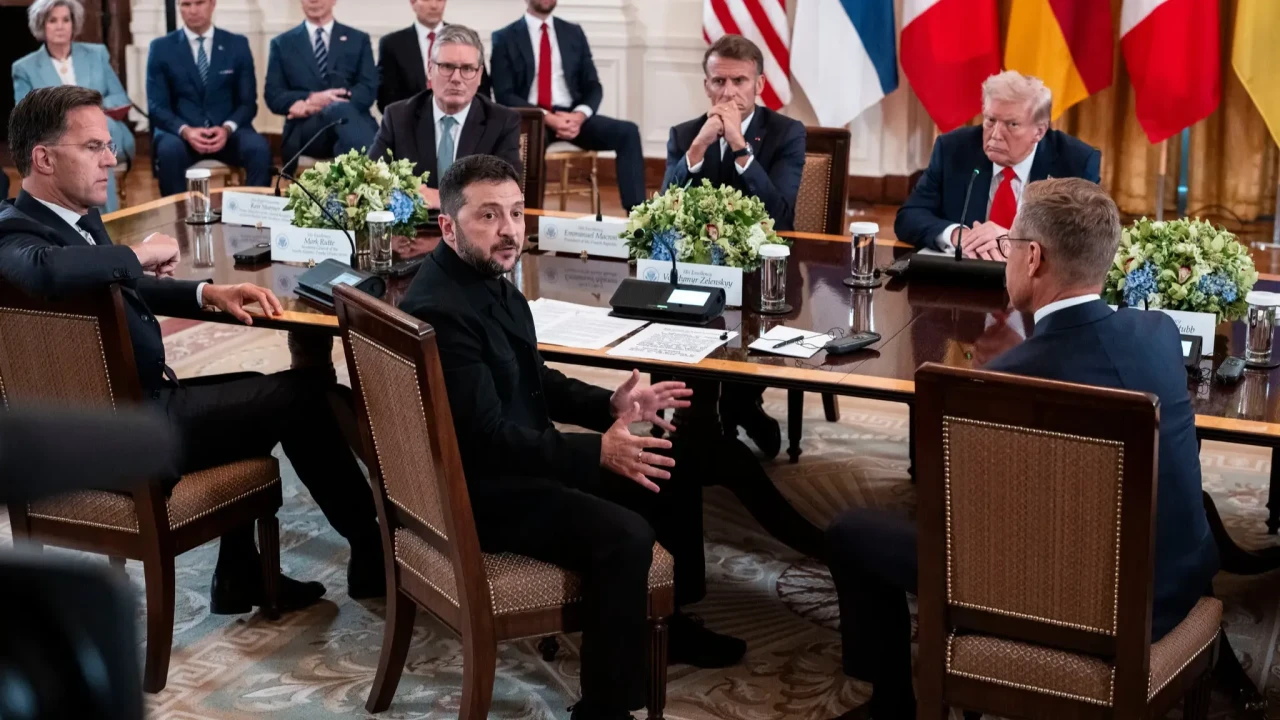
On the other hand, the fact that Ukrainian President Zelensky went to the White House together with the European states had the potential to create pressure. However, the picture that emerged shows that the United States is still the dominant actor in international decision-making. Behind the scenes, the US and Russia could reach a compromise over energy, natural resources or security guarantees. In this case, Ukraine becomes a bargaining chip for the great powers. Although some thinkers characterize this annexation as a "necessary intervention" in the context of protecting a state's border security, in the 21st century, annexing the borders of a sovereign state for the sake of "expanding borders" is not a legitimate action.
The inability of states to reach a compromise due to conflicts of interest continues to wear both Russia and Ukraine down economically, politically and psychologically. In this context, the outcome of the talks between Putin and Trump will carry important signals that will affect not only the future of the Ukrainian war, but also the international perception of other states' borders. The fact that the meeting was held in Alaska has a symbolic meaning. In fact, Alaska was purchased from Russia by the US in 1867 for 7.2 million dollars. This historical background reminds us that the exchange of territories is not only possible through military means, but also through diplomatic and economic agreements. If a "peace agreement" emerging from these negotiations results in Ukraine giving up certain territories, this will be a serious breaking point in terms of international law and sovereignty principles. Such a development would demonstrate that the concept of sovereignty can be stretched in line with interests and that the reshaping of borders can be legitimized in the international system. Time will tell how Putin's stance on this point and his claims over Ukraine will be reflected in the perspective of international relations. While the peace corridor in the Caucasus constitutes a different dimension of the perspective, it is possible that the US will try to adapt it on the Russia-Ukraine axis. However, since the Kremlin will not compromise its sovereignty at this point, it is a fact that it will not accept a conditioning that serves the White House, as in the case of Azerbaijan and Armenia.
Keywords: #RussiaUkraine #War, Peacebuilding, #US Foreign Policy, #Trump #Zelensky #Putin
No comments yet. Be the first!