

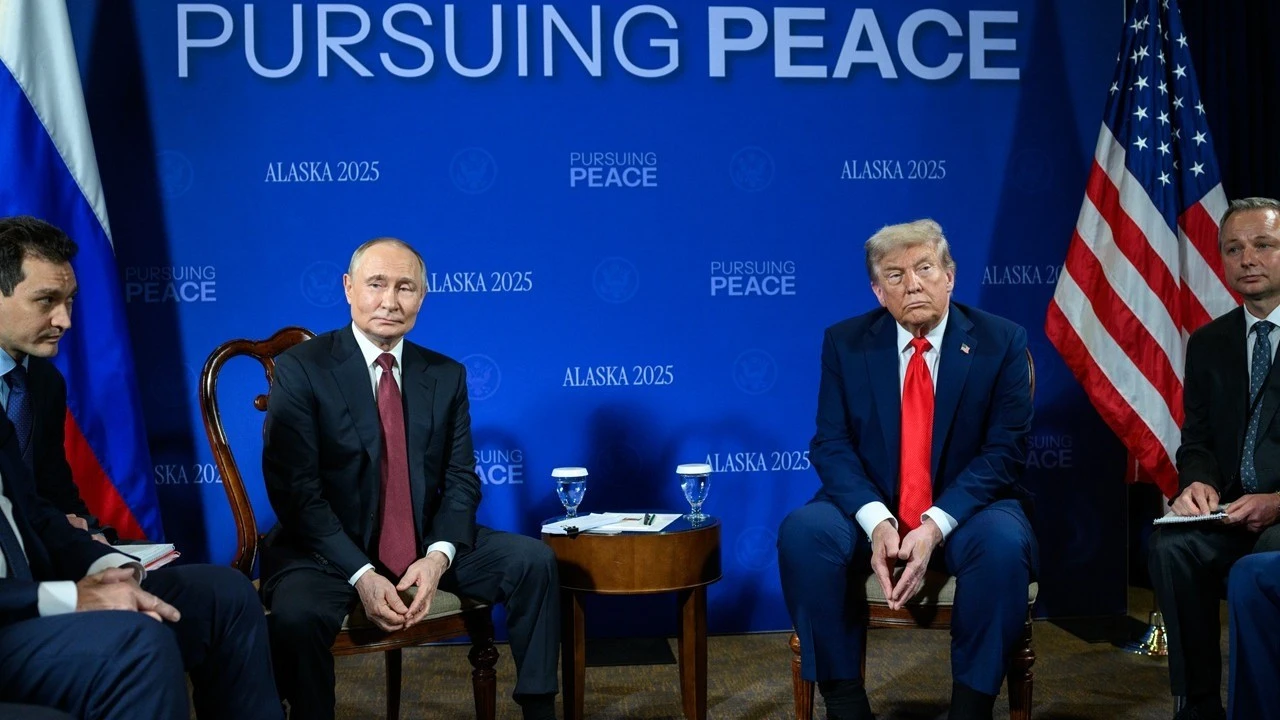
The Alaska Summit, which brought the United States and Russia together again after a long hiatus, has gone down in history as one of the most critical diplomatic contacts of recent years. The fact that the parties did not reach a written agreement at the end of the negotiations was perceived by European states, in particular, as "long-term uncertainty rather than temporary relief."[1] For European states, this meeting was not only about the US and Russia coming together; it also meant a reaffirmation of the extent to which their security architectures are at the mercy of external actors. The main concern expressed in Europe after Alaska was embodied in the question: "Will others decide about our own security?"
Indeed, the reactions of European leaders support this concern. Numerous European leaders, including German Chancellor Merz, French President Macron, and British Prime Minister Starmer, emphasized in their statements immediately after the summit that Europe should not be excluded from negotiations regarding the future of Ukraine.[2] In particular, French President Macron's statement that "Security guarantees should be binding, not symbolic" is a clear indication that Europe is not happy with being directed by Washington.[3]
These concerns have been further strengthened by the war in Ukraine. Especially when peacebuilding is discussed, the idea of offering Ukraine security guarantees similar to those of the North Atlantic Treaty Organization (NATO) is high on the agenda of the Washington summit. This proposal, also brought to the table by Moscow, is seen as a "transitional formula." In this framework, Ukraine will not officially become a NATO member country, but will receive "protection guarantees" from the US and some European countries.[4] This practice brings a two-pronged dilemma for Europe: on the one hand, the security guarantees given to Ukraine are seen as a positive step, while on the other hand, Ukraine's remaining in a US-centric equation pushes it into a secondary role in the European security architecture. Eastern countries such as the Baltic states and Poland have expressed concerns that their own security could be directly jeopardized if these guarantees remain insufficient and merely symbolic.[5]
This situation has given a new perspective to the concept of "strategic autonomy," which has long been debated within the European Union (EU). The Alaska summit, in particular, is a clear indication that Europe cannot escape being a passive follower of Washington's actions without developing its own defense capabilities.[6]
While coalition partners in Germany have for the first time openly voiced the idea of increasing the defense budget to 3%, France has reiterated its call for "the unification of the European defense industry." The UK, even outside the EU, has declared its intention to increase its responsibility under the NATO umbrella.[7] However, despite all these statements, the fact remains that European defense is still dependent on the US in terms of concrete capabilities. Without the presence of the US in many areas, from critical air defense systems and intelligence infrastructure to strategic transport capabilities and nuclear deterrence, it currently seems unlikely that Europe can ensure its own security.[8]
The developments following the Alaska summit have also led to the emergence of different voices within Europe. For example, Hungarian Prime Minister Orban evaluated the summit positively, stating that it "made the world safer."[9] This is one of the pro-Russian voices within the EU.[10] On the other hand, the Baltic states and Poland expressed their deep dissatisfaction with the summit, stating that Russia cannot be a reliable ally. Therefore, Europe's security agenda has revealed both its position vis-a-vis the US and its internal cohesion problems. Although there is a general consensus on supporting Ukraine, disagreements continue regarding the means and political parameters by which this support will be provided.
The economic and strategic implications of the summit continue to increase Europe's security concerns. Although the Russian economy, especially in the post-war period, has been shaken by various Western sanctions, it has managed to survive thanks to its deepening trade ties with China. This situation creates a two-pronged security problem for Europe: Firstly, Russia's close relationship with China strengthens a new anti-Western bloc. Secondly, as long as Europe's own commercial and technological security remains dependent on China, it will also increase the risk of being simultaneously pressured in the East and the Pacific. Therefore, the Alaska summit, in addition to being a turning point in US-Russia relations, has also indirectly influenced Europe's security strategy towards China.
The future of security discussions in Europe is largely shaped along three axes. The first axis is the responsibility within NATO.
The first axis is the sharing of resources. The second axis is the institutional nature of the security guarantees given to Ukraine. If these guarantees are entirely based on bilateral agreements with the US, Europe's role in the security architecture will become secondary. However, if a common mechanism can be developed within the EU or NATO, Europe's strategic weight can be maintained. The third axis is whether Europe will increase its own defense industry capacity. If EU joint procurement programs, joint R&D projects, and defense funds are implemented, it seems that "strategic autonomy" can gain real meaning in the long term.
In light of all these developments, the Alaska summit is described as an "awakening" for Europe. While the lack of an agreement at the summit was a short-term relief, it has essentially deepened Europe's security concerns. This process has shown that the continent cannot go beyond being a passive observer of US-led great power diplomacy without building its own security architecture. For European states, solidarity with Ukraine has become more than just a humanitarian and diplomatic duty; it is a matter directly linked to the future of their own security.
In conclusion, the Alaska summit presents European states with two different roadmaps: either they will accept long-term dependence on US security guarantees, or they will aim to become equal actors within the Atlantic alliance by building their own defense capabilities. European leaders face a difficult choice. However, the current situation shows that maintaining solidarity with Ukraine and addressing security concerns with concrete steps is inevitable.
Keywords: #AlaskaSummit, #RussiaUkraineWar, #USRussiaRelations, #EuropeanSecurityDilemma
[1] “World Leaders React to Trump-Putin Summit Reaching NO Deal on Ukraine,” Reuters, https://www.reuters.com/world/europe/world-leaders-react-trump-putin-summit-reaching-no-deal-ukraine-2025-08-16/, (Accessed: 16.08.2025).
[2] “Los Líderes de la UE y la OTAN Acompañarán a Zelenski a Washington Para Verse con Trump, El País.” https://elpais.com/internacional/2025-08-17/los-lideres-de-la-ue-y-la-otan-acompanaran-a-zelenski-a-washington-para-verse-con-trump.html, (Accessed: 17.08.2025).
[3] “Macron Says Lasting Peace in Ukraine Must Include Unwavering Security Guarantees”, Anadolu Agency, https://www.aa.com.tr/en/europe/macron-says-lasting-peace-in-ukraine-must-include-unwavering-security-guarantees/3661300, (Accessed: 17.08.2025).
[4] “Putin Agreed to NATO-Style US Security Guarantees For Ukraine at Alaska Summit, Witkoff Says”, New York Post, https://nypost.com/2025/08/17/us-news/putin-agreed-to-nato-style-us-security-guarantees-for-ukraine-at-alaska-summit-witkoff-says/, (Access Date: 16.08.2025).
[5] “Nordic, Baltic Leaders Say They Remain Steadfast in Support of Ukraine”, Reuters, https://www.reuters.com/world/europe/nordic-baltic-leaders-say-they-remain-steadfast-support-ukraine-2025-08-16/, (Access Date: 16.08.2025).
[6] “Trump-Putin Summit Prompts Calls for Rearmament in Europe”, The Times, https://www.thetimes.com/world/russia-ukraine-war/article/trump-putin-summit-rearmament-europe-3sk7gqztf, (Access Date: 17.08.2025).
[7] “Strategic Defense Review 2025, Making Britain Safer, Secure at Home, Strong Abroad”, Gov.UK, https://www.gov.uk/government/publications/the-strategic-defence-review-2025-making-britain-safer-secure-at-home-strong-abroad/the-strategic-defence-review-2025-making-britain-safer-secure-at-home-strong-abroad, (Access Date: 17.08.2025).
[8] “Can Europe Really Defend Itself Alone?”, The Guardian, https://www.theguardian.com/world/ng-interactive/2025/jun/24/visual-guide-can-europe-really-defend-itself-alone, (Access Date: 17.08.2025).
[9] “European Leaders To Join Zelenskyy in Washington Meeting with Trump”, AP News, https://apnews.com/article/european-leaders-white-house-meeting-zelenskyy-trump-d7b082bae4136ef8932e16ac2d166303, (Access Date: 17.08.2025).
[10] “World Safer After Trump-Putin Summit, Orban Says”, Daily News Hungary, https://dailynewshungary.com/world-safer-trump-orban-summit-orban-says/, (Accessed 17.08.2025).
No comments yet. Be the first!